
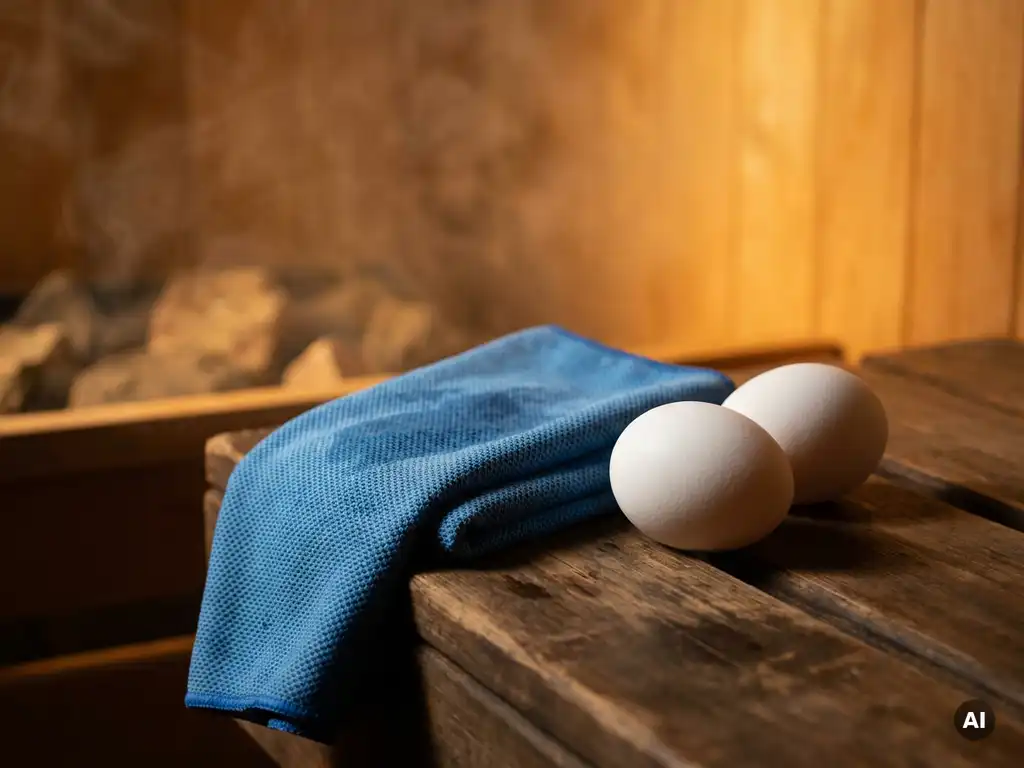
Most people bring a cooling towel into the sauna and then wonder why it stops working after a few minutes. They dampen it under a tap, drape it somewhere on their body, and expect it to keep performing through the entire session. It does not. A sauna cooling towel only works as well as the preparation and technique behind it, and without both, you are carrying a warm, damp cloth into one of the hottest environments your body will ever encounter.
A sauna cooling towel works by drawing heat away from your skin through evaporative cooling, the same mechanism your body uses when it sweats. Cold moisture on the fabric surface evaporates, and that phase change pulls heat away from the contact area. When placed correctly over the groin, where the femoral artery runs close to the surface, that local cooling effect reaches your circulating blood and produces a systemic benefit that goes well beyond simple comfort. But none of that happens if the towel is warm, too wet, too dry, or sitting in the wrong place.
This guide walks you through every stage of using a sauna cooling towel correctly: how to prepare it before you enter, where and how to place it, when to refresh it mid-session, how to time your cooling intervals for maximum effect, and how to care for it after each use so it keeps performing session after session. Whether you are using a home sauna or a shared facility, each of these steps is practical, specific, and grounded in how the towel and your body actually work together.
What you need before your sauna session
The single biggest mistake people make with a sauna cooling towel is treating preparation as optional. Your towel’s effectiveness during the first round depends entirely on its starting temperature and moisture level at the moment you sit down. A towel that enters the sauna at room temperature will warm to the ambient air within a few minutes, leaving you with no effective cooling window at all. Preparation takes less than five minutes, but skipping it wastes the entire first round.
The three main pre-chilling methods each have their place depending on how much time you have. The freezer method is the most effective: dampen the folded towel, place it in the freezer for fifteen to thirty minutes before your session, and remove it just before you enter. The goal is a very cold, pliable towel, not a frozen block. If it has been in too long and feels rigid, let it sit at room temperature for two to three minutes before use. The refrigerator is more forgiving and ideal when you are preparing an hour or more in advance. Thirty to sixty minutes produces a well-chilled towel at roughly 4 to 8 degrees Celsius without any risk of freezing. If you have no advance time at all, submerge the folded towel in a bowl of ice water for three to five minutes. This is the fastest option and works well for spontaneous sessions.
Moisture level matters just as much as temperature. The towel cools through evaporation, so it needs to be damp, but not saturated. After chilling or removing from ice water, wring the towel firmly with both hands until no water drips when you hold it vertically. It should feel cool and slightly moist, not heavy or wet. Do not use warm water at any point in this process. Warm water defeats the purpose of pre-chilling and dramatically shortens your effective cooling window from the first moment of contact. Once the towel is chilled, wrung, and folded into its placement shape, carry it in a small insulated bag or wrapped in a dry outer towel to slow warming during transit. A towel left sitting at room temperature for more than five minutes before you enter has already begun losing its starting temperature advantage.
Your five-point pre-session checklist
- Towel is pre-chilled using the freezer, refrigerator, or ice water method
- Towel is dampened evenly and wrung until no water drips when held vertically
- Towel is pre-folded into its placement configuration and ready to apply without adjustment inside the sauna
- A second towel or ice water reserve is prepared if you are doing multiple rounds
- No fabric softener, scented products, or hot water has been used at any stage of preparation
Place and position the towel correctly
Where you place the towel matters more than most people realise. The groin area is one of the most effective cooling targets on the body because the femoral artery and its branches run close to the surface here. When you cool the skin over that vascular pathway, you are cooling blood that is actively circulating through your body. That is the same principle used in sports medicine cooling protocols and clinical cooling vests: targeting a major superficial artery produces a systemic effect that far exceeds what you would get from cooling an equivalent area of muscle or skin elsewhere.
To fold the towel correctly, lay it flat and fold it lengthwise into thirds to create a long, narrow strip. This shape concentrates the cooling fabric across the groin crease and inner thigh without bunching. If you are larger in build, fold in half rather than thirds to achieve adequate width for full contact. The goal is a flat, even strip that sits flush against the skin with no ridges or raised edges, because any gap between the fabric and your skin reduces the conductive heat transfer that makes the towel effective.
For placement while seated, hold the folded towel at both ends and lay it across the groin area, centred on the hip crease where your torso meets your upper thigh. Press gently along its length to eliminate air gaps, then let the natural weight of the towel maintain contact. You should not need to hold it in place. If your primary goal is vascular cooling, shift the towel slightly inward toward the inner thigh to maximise proximity to the femoral vessels. Avoid placing it directly on top of a sauna towel or shorts. Even a thin fabric layer between the cooling towel and your skin significantly reduces heat transfer. The towel needs to be against bare skin to work properly. Check and smooth it every few minutes, particularly after any position shift, and re-centre by lifting and replacing rather than dragging, which causes bunching.
Re-cool and refresh the towel mid-session
A cooling towel does not perform indefinitely. In a sauna running at 80 to 100 degrees Celsius, an adequately dampened towel typically remains effective for eight to fifteen minutes before it warms to the point where it no longer produces a perceptible cooling sensation. Higher ambient heat, lower humidity, and greater airflow all shorten that window. The towel loses effectiveness because the moisture on its surface evaporates and the residual fabric warms to near body temperature. At that point, it is no longer drawing heat away from your skin. You will notice the towel feels warm or neutral rather than cool, the fabric feels significantly drier than when you first applied it, and sweating in the covered area resumes at a rate similar to uncovered areas.
The fastest way to restore cooling capacity is to rinse the towel under a cold tap, wring it back to the correct dampness level, and reapply. The re-cooling effect is immediate. If you have access to an ice bucket or insulated cooler, submerging the towel briefly before wringing produces a colder starting point than tap water alone, which is particularly useful in multi-round sessions where you want consistent cooling across each round. A small soft-sided cooler with a sealed ice pack placed just outside the sauna door maintains water temperature for a full session without needing refills. If you are at a home sauna, this setup is straightforward to arrange. If you are at a gym or spa, a small insulated bottle of ice water carried in your bag is a discreet and practical alternative.
Rotating between two towels eliminates any gap in cooling during the re-cooling process. While one towel is being rinsed or re-chilled, the second is immediately available. This approach suits home sauna users with easy access to cold storage. In public environments, a second towel stored in your bag near the changing area serves the same purpose. When you leave the sauna to re-cool the towel, treat it as a natural rest interval between rounds rather than an interruption. The rhythm of heat round, exit, re-cool towel, rest, and re-enter is a structured and repeatable format that aligns with standard multi-round sauna practice.
Time your cooling intervals for best results
Applying your cooling towel at the right moment within a sauna round matters more than most people expect. During a standard session, your core body temperature rises progressively, typically reaching 38.5 to 39 degrees Celsius, triggering vasodilation and increased cardiovascular output. Cooling is most effective and most needed when your body’s heat load is at its peak, not before it has built up and not after it has already begun to dissipate on its own. Applying the towel too early in a round reduces the heat stimulus before it has had time to produce its intended physiological effect. Applying it too late, after you have already exited and your body is cooling passively, reduces its practical impact on both comfort and recovery.
In a standard round of ten to fifteen minutes, a practical approach is to enter without the towel, allow the heat exposure to build, and apply the towel during the final three to five minutes of the round when heat load is highest. Maintain placement through the transition out of the sauna and into your rest interval to support your body’s natural cooling descent. Traditional Finnish dry saunas and steam rooms produce rapid surface heating, so the peak heat load arrives relatively quickly. Infrared saunas heat core tissue more gradually at lower ambient temperatures, which means the optimal cooling window tends to arrive later in the round. Being aware of which type of sauna you are using helps you judge when to apply the towel rather than defaulting to a fixed time.
Across a three-round session, the role of the towel shifts. In round one, let the heat exposure build fully before applying the towel late in the round. Re-cool the towel during your first rest interval so it is cold and ready before re-entry. In round two, apply it earlier if your heat tolerance has decreased or if you are feeling the cumulative load more strongly. By round three, which is typically the most demanding, apply the towel from the outset if needed and prioritise a thorough cool-down immediately after exiting. One important consideration: sustained heat exposure is what drives the production of heat shock proteins, which support cellular repair and recovery. Cooling too early or too aggressively truncates that stimulus. The towel is designed to manage comfort and support cardiovascular recovery, not to replace the heat exposure itself. Use it to extend your effective time in the sauna, not to reduce it.
Care and maintenance after each use
How you treat the towel after each session directly determines how well it performs in the next one. Rinse it immediately after use under cool or lukewarm water, not hot, which can break down synthetic fibres over time. Rinse until the water runs clear to confirm you have removed sweat, body oils, and any mineral deposits from the fabric. Gently wring rather than twisting aggressively, which can distort the weave. This immediate rinse is not just about hygiene. It preserves the evaporative cooling mechanism embedded in the fabric structure by preventing the build-up of residue that clogs the fibres and reduces absorbency.
Machine wash the towel after every two to three uses, or immediately if it is heavily soiled. Use a gentle or delicates cycle with cold water and a small amount of mild, fragrance-free detergent designed for performance textiles. Wash it separately from heavy cotton items like regular towels or jeans, which cause abrasion and pilling on the cooling towel surface. Pilling is not just cosmetic. It reduces the smooth contact area that makes skin-to-fabric heat transfer effective, so a pilled towel is a functionally degraded towel.
Avoid fabric softeners entirely. This is worth understanding at the chemistry level, not just accepting as a rule. Fabric softeners work by depositing a silicone-based coating on fibres that makes them feel softer. That same coating is hydrophobic, meaning it actively repels moisture. For a cooling towel, which depends entirely on its ability to absorb and hold water for evaporative cooling, a fabric softener coating progressively destroys the towel’s core function with every wash. The same principle applies to sauna towels, which rely on open, absorbent fibre structures to wick moisture from the body. Using fabric softener on any performance textile is counterproductive for the same underlying reason. Skip it entirely for both. Also avoid bleach and enzyme-based detergents, which degrade synthetic and hybrid natural fibres over time.
Drying and storage
Air drying is the best option. Hang the towel flat or drape it over a rack in a well-ventilated area away from direct sunlight. UV exposure fades colour and weakens synthetic fibres at a molecular level over repeated sessions. Make sure the towel is fully dry before folding or storing it. A towel folded while still damp creates an anaerobic environment where odour-causing bacteria multiply rapidly, and repeated damp storage leads to permanent mildew odour that washing cannot fully remove. If you need to machine dry, use the lowest heat setting available and remove the towel promptly once dry. High heat causes synthetic fibres to contract and lose their engineered texture, which affects how the towel sits against your skin.
Store the towel loosely folded in a breathable bag or on an open shelf rather than compressed in a sealed plastic container. Keep it away from radiators or direct sunlight between sessions. If pre-chilling is part of your preparation routine, store it near the freezer so it is easy to grab and prepare without adding friction to your pre-session process. A dry, clean towel stored correctly will reach optimal cooling performance faster when dampened before your next use.
Putting it all together
Using a sauna cooling towel correctly is not complicated, but it does require consistency across every stage: preparation before you enter, precise placement once you are seated, timely refreshing during the session, and proper care after each use. Each of these steps reinforces the others. A well-prepared towel placed over the right vascular target, refreshed at the right moment, and cared for properly between sessions will perform reliably round after round. A towel that is warm on entry, positioned loosely over the wrong area, left damp in a bag after use, and washed with fabric softener will feel like it barely works at all, because functionally, it barely does.
The groin cooling approach works because it targets one of the most accessible vascular pathways on your body, and the towel works because evaporative cooling is genuinely effective at drawing heat away from skin in contact with it. Those two facts do not change. What changes is how much of that potential you actually capture through your technique. Follow the steps in this guide consistently and you will notice the difference from the very first session. If you found this useful, share it with someone who uses a sauna regularly, or explore our other guides on sauna accessories and session structure to get more from every session you do.