
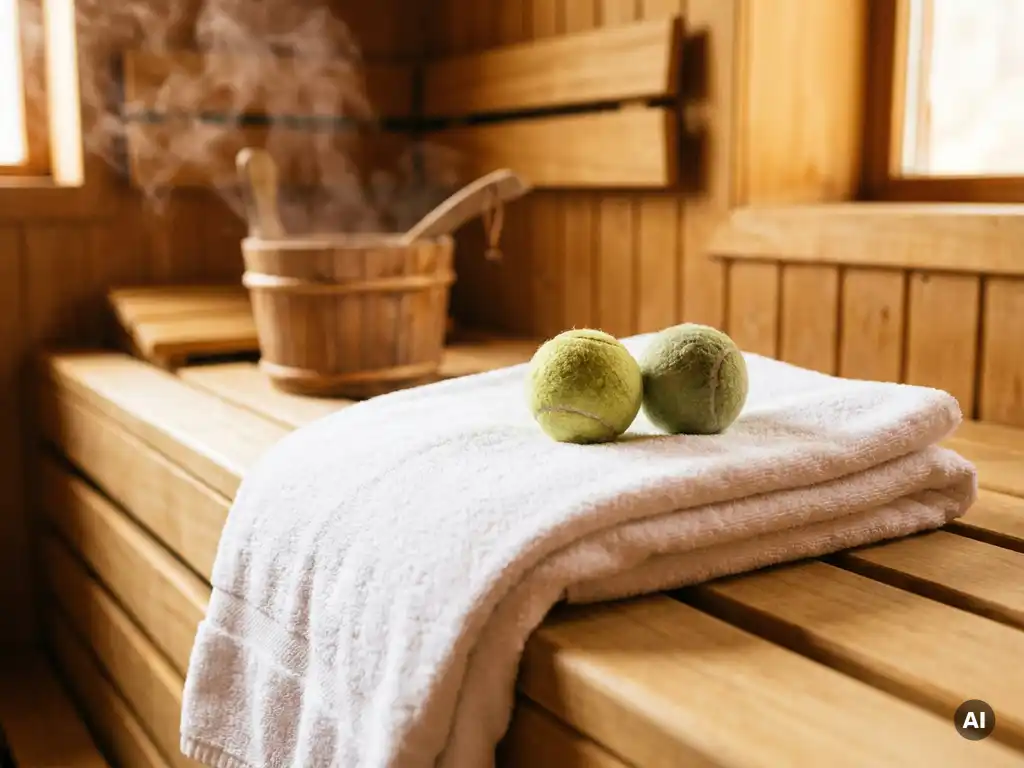
Most men who use saunas regularly give almost no thought to what the heat is doing to their testicles. You sit in, you sweat, you feel great. But the scrotal area is one of the most heat-sensitive regions of the male body, and sustained exposure to high temperatures can push testicular temperature well above its normal range. A sauna cooling towel is one of the simplest tools you can use to manage this, but only if you know how to use it properly.
The problem is that most guidance on keeping your balls cool in the sauna stops at “bring a cold towel.” That is not enough. The type of sauna you are in, the timing of your application, how you prepare before the session, and how you maintain cooling across multiple rounds all determine whether your cooling towel actually does anything useful or just sits there warming up in your lap.
This guide covers everything you need to know: what to prepare before you walk in, when and how to apply your cooling towel, how to sustain cooling across a full session, and how to adjust your approach depending on whether you are in a dry Finnish sauna, a steam room, or an infrared sauna. By the end, you will have a practical, repeatable routine you can follow from your very first session.
What you need before your sauna session
Effective groin cooling does not start inside the sauna. It starts in the five minutes before you walk in. If you wait until you are already sitting in 90 degrees of heat to think about your cooling setup, you have already lost the window for your first application. A small amount of preparation beforehand makes the entire process easier, more consistent, and far more effective.
The most important item is your cooling towel itself. A thin microfibre or lightweight cotton cloth works best because it absorbs cold water quickly and transfers that coolness efficiently against the skin. Avoid thick, fluffy towels. They hold ambient heat, warm up fast, and create an insulating layer rather than a cooling one. Your towel should be large enough to fold into a compact surface that covers the scrotal area directly, but not so large that it becomes awkward to position and hold. Before entering the sauna, soak it thoroughly in cold water, wring it until it is damp rather than dripping, and store it in a sealed bag or small insulated container to keep it cold until you need it.
Your cold water supply matters just as much as the towel. Identify where the nearest cold tap is relative to your cool-down area and make sure you have a basin or container ready for re-soaking between rounds. If you want more sustained cooling, bring a small cooler or insulated bottle filled with ice water and position it in your cool-down space before you begin. For sessions of three or more rounds, preparing a second pre-soaked towel is worth doing. You can rotate between them during breaks so one is always cold and ready while the other is in use.
Plan your session structure before you enter
Knowing how many rounds you plan to do and roughly how long each will last lets you align your cooling intervals with the natural rhythm of the session. Without this, cooling becomes reactive and inconsistent. Decide in advance whether you are doing two rounds or four, and identify the cool-down breaks where you will re-wet and re-apply your towel. A simple mental plan is enough. You do not need a stopwatch, but having a rough structure means you are not improvising under heat.
Before you go in, run through this quick checklist. Your cooling towel should be soaked, wrung, and stored cold. Your cold water or ice supply should be positioned in the cool-down area. You should know which sauna type you are using and roughly how many rounds you are doing. If you are using a dry Finnish sauna, bring more cold water or ice because you will need to re-cool more frequently. In a steam room, prioritise colder water since the humid air suppresses evaporative cooling. In an infrared sauna, plan for a longer session and an earlier first application. That small mental review before you walk in sets you up to cool proactively rather than scrambling to catch up.
Apply targeted cooling at the right moment
Timing your cooling application is just as important as the technique itself. Apply the towel too late and scrotal temperature has already climbed significantly, meaning your cooling has to work against a larger accumulated heat load. Many people wait until they feel genuine discomfort before reaching for their towel, but by that point the temperature differential they are trying to correct is already substantial. Proactive, scheduled application is consistently more effective than reactive cooling.
The right moment for your first application is at the end of your first heat round, typically after 10 to 15 minutes of heat exposure. By this point your scrotal temperature has risen meaningfully and the cooling will have a clear effect. Physical cues that signal this moment include noticeable sweating in the groin area and a distinct sensation of warmth in the scrotal region. If you prefer a time-based approach rather than relying on sensation, simply apply the towel as you exit the sauna for your first cool-down break and reapply at the start of each subsequent heat round.
Positioning matters more than most people expect. Fold your towel into a compact, concentrated surface rather than draping it loosely across the lap. Place it directly against the scrotum with consistent, light contact. A towel that sits loosely nearby loses contact with the skin and warms from ambient air rather than absorbing body heat, which defeats the purpose entirely. If you are seated, your natural body position can hold the towel in place. If you are lying down, you may need to hold it manually or position it carefully to maintain contact. Keep it in place for a minimum of three to five minutes per application to allow meaningful heat transfer, and replace or re-cool it once it no longer feels noticeably cool against the skin.
Maintain cooling across multiple sauna rounds
A single cooling towel application at the start of your session is not enough. Within minutes, the towel absorbs heat from your body and the surrounding air and becomes a passive warm cloth rather than an active cooling tool. Worse, core and scrotal temperature continue rising cumulatively across rounds even during rest breaks. Passive rest between rounds in ambient air may not bring testicular temperature back to baseline, so each successive round begins from a slightly higher starting point than the last.
The natural rhythm of a multi-round sauna session gives you clear windows for re-cooling. A typical session involves heat rounds of 10 to 20 minutes followed by cool-down breaks of 5 to 15 minutes, repeated two to four times. The cool-down break is your primary opportunity to re-wet or re-chill your towel. Use it. Wring out any residual warm water from the towel before re-soaking it in cold water, because wringing first restores the temperature differential more effectively than simply adding cold water to a warm, saturated cloth. If you have a cooler with ice water, this is the moment to use it.
As the session progresses into later rounds, consider escalating your cooling approach. By rounds three and four, your baseline scrotal temperature entering the heat is higher than it was in round one. Fatigue can also reduce how attentive you are to cooling cues. Switching from cold tap water to ice water for your towel in later rounds compensates for this cumulative heat load. Shorten your re-cooling checks slightly in later rounds rather than extending them. If your towel is no longer producing a perceptible temperature difference against the skin even after re-soaking, that is a signal worth paying attention to.
Adjust your approach for different sauna types
A single cooling strategy does not work equally across all sauna environments. The ambient humidity and temperature of the space you are in directly affects how quickly your cooling towel warms up and how much cooling work it can actually do. Understanding these differences lets you adjust your approach before you walk in rather than discovering mid-session that your towel has gone warm faster than expected.
Dry Finnish saunas and steam rooms
In a dry Finnish sauna, temperatures typically sit between 80 and 100 degrees Celsius with very low humidity. This combination causes rapid evaporation from your towel, which sounds like it should help but actually means the towel dries out and warms up faster than in other environments. Expect to re-wet or re-cool your towel every five to eight minutes rather than waiting for your cool-down break. Keep a container of cold water or a small cooler within reach of where you sit, and apply the towel immediately after entering each heat round rather than waiting until you feel warm.
Steam rooms operate at much lower temperatures, typically 40 to 50 degrees Celsius, but with very high humidity. The high moisture content in the air suppresses evaporation from your towel, so it stays damp longer but gradually warms toward the ambient temperature of the room. The cooling effect may feel less intense than in a dry sauna even though the towel is still wet. To compensate, use colder water or ice water rather than cold tap water, and check the towel temperature by touch every eight to ten minutes rather than relying on dryness as your cue. Wring and re-soak more often to restore the temperature gap between the towel and your skin.
Infrared saunas operate at moderate temperatures between 50 and 65 degrees Celsius, but the heat penetrates tissue directly rather than warming the surrounding air as aggressively. This creates a slower but cumulative rise in core and scrotal temperature that can be easy to underestimate. Because the ambient air feels more comfortable than in a Finnish sauna, you may feel less urgency about cooling. Start your first application earlier in the session than you would elsewhere, and use moderate re-cooling intervals of around 10 to 12 minutes given the lower ambient temperature. Pay attention to session duration because infrared sessions often run longer than dry sauna rounds, which compounds the total heat exposure.
Conclusion
Keeping your balls cool in the sauna comes down to preparation, timing, and consistency. Prepare your cooling towel and cold water supply before you enter. Apply the towel at the end of your first heat round rather than waiting for discomfort. Re-cool and reapply at every cool-down break, escalate your cooling in later rounds, and adjust your re-cooling frequency based on whether you are in a dry Finnish sauna, a steam room, or an infrared sauna. None of these steps are complicated, but they work together as a system. Skipping one weakens the others.
If you are ready to make scrotal cooling a consistent part of your sauna routine, start with the pre-session checklist the next time you visit. Bring a thin microfibre towel, set up your cold water supply in the cool-down area, and commit to your first application at the end of round one. That single change, moving from reactive to proactive cooling, makes a bigger practical difference than any piece of equipment you could buy. Build the habit first, then refine the tools around it.