9 Christmas Gifts for Sauna Lovers That Aren’t Another Bathrobe
The most useful sauna gifts do a specific job during the visit: a bench towel covers the wood, a sauna cooling towel belongs in an airy…
Journal5 min read
Finnish sauna, infrared, and steam room heat your body differently. Find out what that means for testicular temperature.
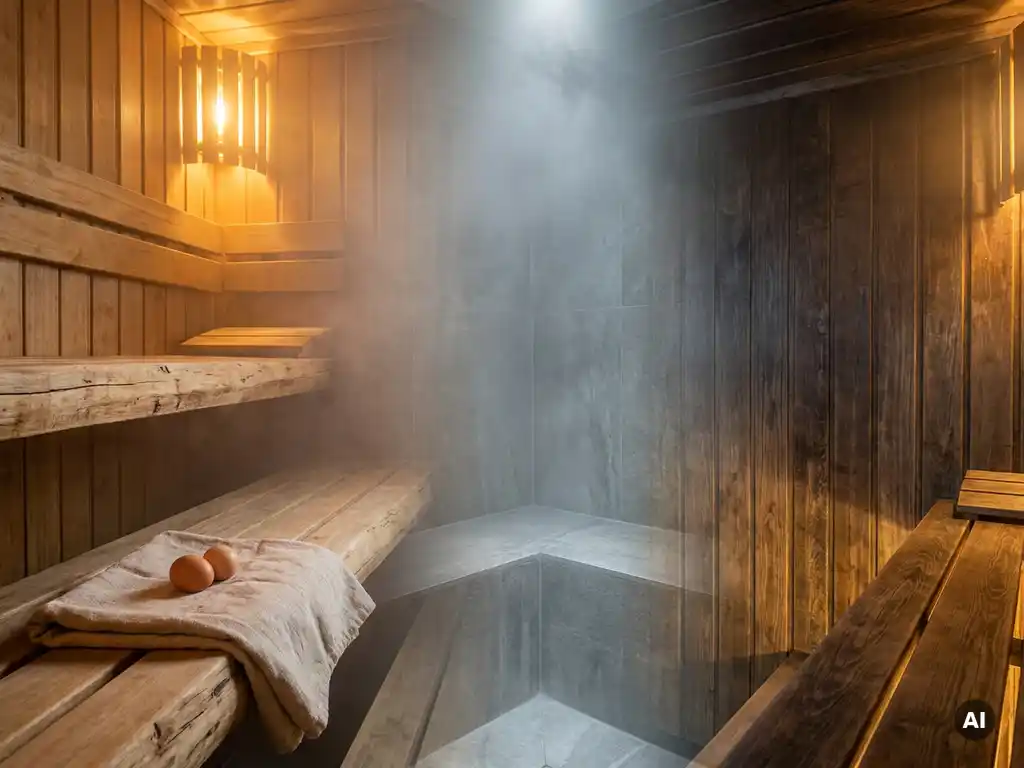
Not all saunas are built the same, and if you’ve ever stepped from a Finnish
sauna into a steam room, you’ll know the difference is immediate and striking.
The air feels different, the heat lands differently, and your body responds in
its own way to each environment. For most people, these distinctions are just
a matter of personal preference. But if you’re thinking about
testicular temperature and what prolonged heat exposure might
mean for your reproductive health, understanding exactly what each format does
to your body becomes a more practical question.
This comparison breaks down the three most common sauna environments
— Finnish sauna, infrared sauna, and steam room — so you can make an informed
choice about how you use them and what, if anything, you want to do to manage
heat around the groin.
Each sauna type creates a distinct climate through a different combination of
temperature, humidity, and the mechanism used to generate heat.
A Finnish sauna typically operates between
80°C and 100°C (176°F to 212°F) with low relative humidity,
usually between 10% and 20%. Heat is generated by pouring water over hot
stones, which produces short bursts of steam called löyly. The air
itself is the primary carrier of heat, and the low moisture content means
sweat evaporates quickly from your skin, which is part of why the high
temperature feels tolerable.
An infrared sauna runs at much lower air temperatures,
typically between 45°C and 65°C (113°F to 149°F), with
similarly low humidity. Instead of heating the air, infrared panels emit
radiant energy that is absorbed directly by the body’s surface tissue. The
room itself stays relatively cool compared to a Finnish sauna, but the
heat penetration into the body can feel more intense than the
ambient temperature suggests.
A steam room operates at lower temperatures than a Finnish
sauna, usually 40°C to 50°C (104°F to 122°F), but with
near-100% relative humidity. The saturated air prevents sweat
from evaporating, which means your body cannot cool itself through perspiration
as effectively. The result is that even though the temperature is lower, the
thermal stress on the body can be significant.
The mechanism of heat transfer matters as much as the
temperature reading on the wall, because it determines how quickly and deeply
your core and skin temperature rise.
In a Finnish sauna, convective heat from the hot air warms
the skin surface rapidly. Sweat evaporation provides a natural cooling buffer,
which is why experienced sauna users can tolerate temperatures that would be
dangerous in other conditions. The intermittent bursts of steam from
löyly create brief spikes in perceived heat, but the overall
experience is cyclical rather than sustained.
Infrared saunas work through radiant heat, which bypasses the
air and acts directly on the body’s tissues. This means the heating effect can
feel more penetrating, even at lower ambient temperatures. Some users find that
infrared sessions produce a deeper sweat with less surface discomfort, though
the core body temperature response is broadly comparable to traditional sauna
use at equivalent exposure times.
Steam rooms present a different challenge. Because the air is already saturated
with moisture, sweat cannot evaporate efficiently. Your body’s
primary cooling mechanism is essentially blocked, which causes skin and core
temperature to rise more steadily throughout the session. Even at 45°C, a
20-minute steam room session can produce a significant increase in body
temperature, sometimes comparable to a shorter Finnish sauna session at twice
the air temperature.
Testicular temperature is normally kept a few degrees below
core body temperature, a biological arrangement that supports healthy sperm
production. When the surrounding environment raises scrotal temperature, that
margin narrows.
Research on sauna use and male fertility, particularly studies on Finnish sauna
use, has consistently shown that repeated sessions raise scrotal temperature
measurably. The effects on sperm parameters observed in some studies appear to
be temporary and reversible in healthy men, though the evidence
base is still developing and individual responses vary. What the research does
establish clearly is that heat exposure in the scrotal region
is the relevant variable, not the sauna format itself.
From that perspective, the steam room may present the most sustained thermal
challenge to testicular temperature, because the body’s ability to self-cool is
most compromised. A Finnish sauna session at a higher temperature but with
functioning sweat evaporation may produce a shorter or less sustained rise in
scrotal temperature than a longer steam room session. Infrared saunas, with
lower air temperatures and radiant rather than convective heat, may produce a
more gradual temperature increase, though this depends heavily on session length
and individual physiology.
If keeping your testicles cool during sauna use is a priority — whether out of
general wellness interest or because you’re thinking about fertility — the
format you choose is one variable. The following factors are equally relevant:
There is no universally “safer” sauna format when it comes to testicular heat,
but there are meaningful practical differences worth factoring into your
routine.
If you use a sauna regularly and want to minimise sustained scrotal
heat exposure, shorter sessions with cooling breaks are a sensible
baseline across all three formats:
Whatever format suits you, the principles of managing testicular heat remain
consistent:
Understanding the environment you’re in gives you the context to make those
decisions with a bit more precision.

The most useful sauna gifts do a specific job during the visit: a bench towel covers the wood, a sauna cooling towel belongs in an airy…

A useful sauna gift box has a few items with different jobs: coverage or comfort during a session, then a sauna cooling towel for breaks if…