
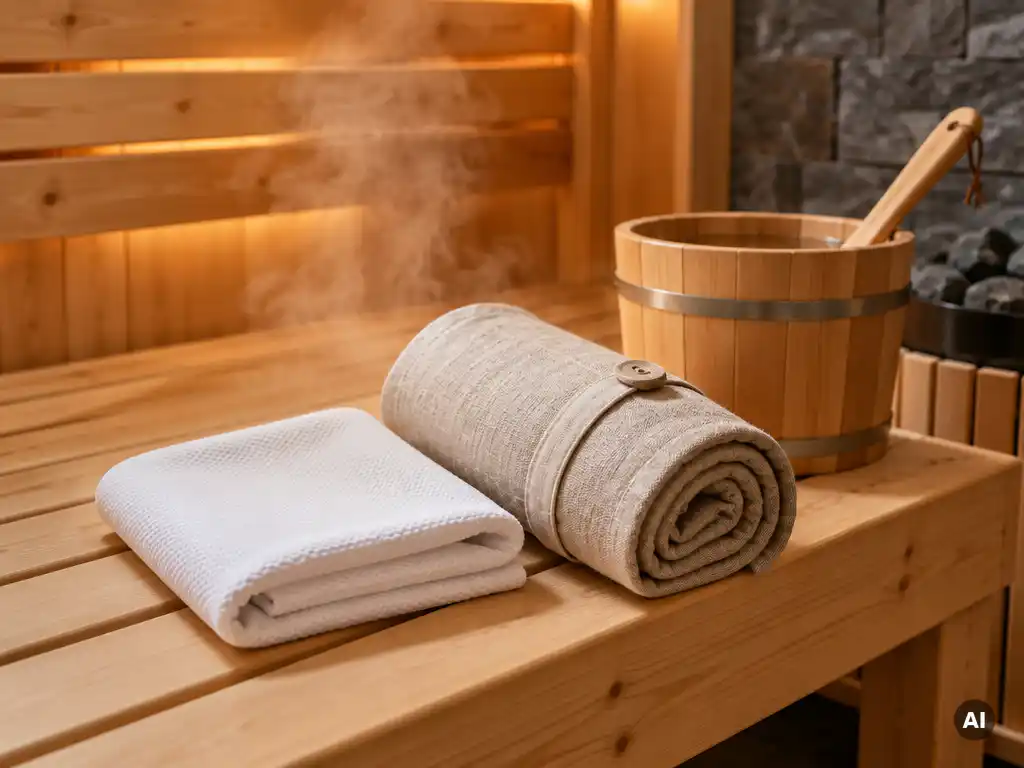
No, you do not need both: a sauna kilt gives you secure coverage, while a sauna cooling towel adds optional, localised cooling. The venue’s clothing rules come first, and a required seat towel remains a separate item.
1. Venue rules come before either accessory
Check the venue’s clothing policy before choosing a wrap. Visit Jyväskylä Region describes nude bathing as usual in Finland, while also accepting a swimsuit or a towel. Some public saunas require swimwear, so a kilt is not automatically an alternative.
Coverage and bench hygiene are different questions. The regional sauna guidance advises bringing a seat towel whether you bathe nude or wear a swimsuit, and showering before you enter. If your venue requires a seat towel, pack one even if you plan to wear a kilt.
2. A kilt stays fastened when coverage matters
A sauna kilt is a wrap worn as a skirt or dress, secured with Velcro or buttons. It covers the body and may also cover the part of the bench beneath you. Compared with an unsecured bath towel, its fastening is intended to keep the wrap from slipping when you move.
That makes a kilt the more practical choice if you want dependable coverage, provided the venue permits it. Check the fastening and dimensions against how you intend to wear it: Sowel’s Sauna Buddy, for example, is 60 × 140 cm with a Velcro fastening. Its ability to cover some bench surface does not satisfy a venue’s separate seat-towel rule.
3. Evaporation gives a damp towel its cooling effect
A sauna cooling towel does a different job. Water held in the fabric evaporates from exposed areas, taking heat with it; Frogg Toggs says its Chilly Pad must stay wet and exposed to air to keep cooling. It describes the material as polyvinyl alcohol, or PVA, a sponge-like synthetic material. Ergodyne suggests wearing its PVA towel around the neck or head.
The effect is localised to where you use the damp fabric. Feeling cooler at your neck or head is not a measured fall in core body temperature, nor does it establish a fertility benefit. Choose a cooling towel for comfort, not as a way to make an overly hot sauna session safe to prolong.
4. Cooling duration depends on keeping the towel wet
Ergodyne advertises up to four hours of cooling for its Chill-Its 6602. That is a product maximum, not a promise that it will cool for four hours in sauna conditions. The practical limit is how long the fabric remains damp and exposed to air.
Prepare it before the session and re-wet it when the effect fades. For its Chilly Pad, Frogg Toggs instructs users to wet it again in hot or cold water and wring it out. The maker permits dry storage and hand or machine washing when dirty, but advises against freezing the wet towel because that can make the material brittle. Ergodyne’s directions say to air-dry its PVA towel until stiff, then re-wet it to soften and reactivate it.
A towel is not a substitute for a cool-down break. Visit Jyväskylä Region suggests roughly 10–15 minutes of bathing before cooling off and moving to a lower bench if the upper seats feel too hot.
5. Both belong in the bag only if you want both jobs done
If secure coverage is the only job you need done, a permitted kilt is enough; an ordinary towel may also suit you if its less secure wrap does not bother you. If you want localised cooling, add a damp cooling towel and expect to re-wet it. Packing both makes sense when you want both functions, not because one accessory completes the other.
Coverage and cooling are separate choices
The venue’s seat-towel rule determines what you must bring, regardless of which accessories you use.