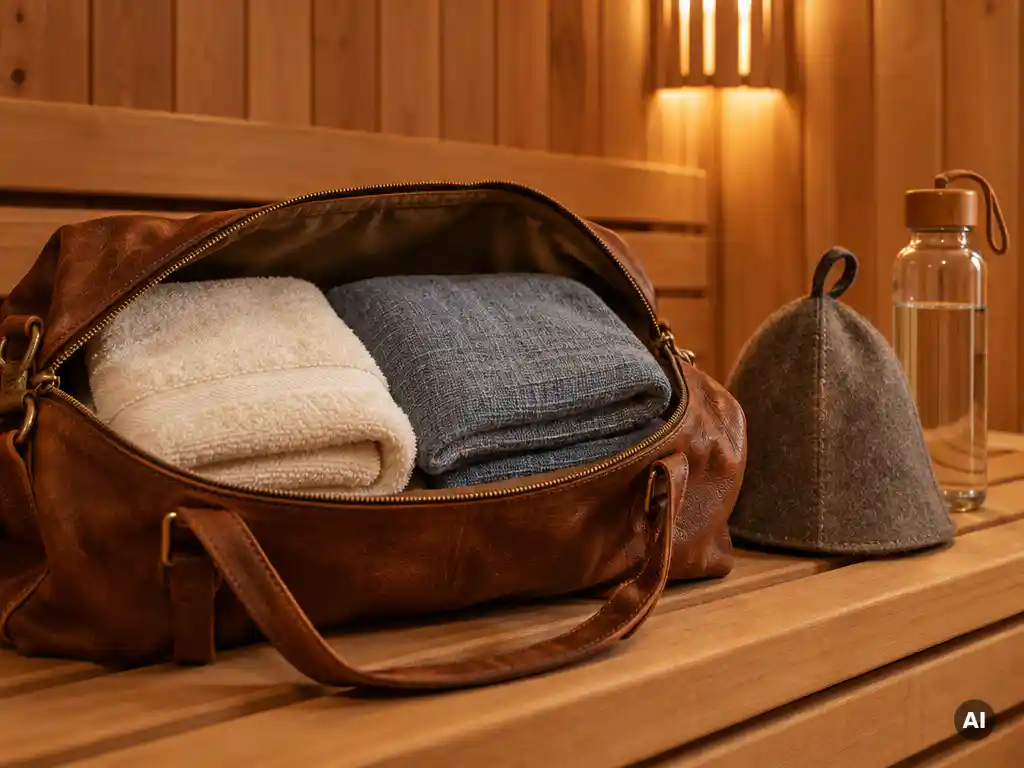
A lightweight linen or cotton–linen towel suits a compact sauna bag if it covers the bench; cotton terry suits you better if a plush, absorbent towel matters more than packing space. Weave and size affect the choice, as does whether you carry a separate towel for drying.
Linen or cotton–linen for compact bench coverage
Linen and textured cotton–linen are sensible choices when you want bench coverage without packing a thick terry towel. MÖVE considers both pure cotton and a textured cotton–linen blend suitable for sauna use, leaving the feel to personal preference. A lightweight towel still has to cover the part of the bench your body will touch.
Moisture figures do not settle which finished towel will absorb more liquid. A textile-conservation reference lists moisture regain at 12.0% for flax and 8.5% for raw cotton, measured at 65% relative humidity and 21.1 ± 0.1°C. That measures moisture relative to the fibre’s oven-dry weight, not how much water a woven towel can take up.
In a commissioned fabric comparison, the tested linen allowed more airflow than the other materials and absorbed liquid immediately, spreading it most widely. Those results describe the tested fabrics, not every sauna towel. Construction and usable size remain more practical buying criteria: the Linen Tales fine-waffle towel is 100% linen, 200 g/m² and 75 × 125 cm, so its length needs checking against the bench you intend to cover.
Cotton terry puts absorbency and bench feel first
Cotton terry earns its place if you prefer a cushioned surface and want the towel to take up water. MÖVE describes terry’s loops on both sides as durable and highly absorbent, while treating pure cotton and textured cotton–linen as suitable alternatives. Do not turn a fibre comparison into a durability verdict. A textile-conservation reference says a linen fibre is stronger than a comparable cotton fibre; it does not follow that any particular linen towel will outlast a particular terry one. Choose between these towels based on the construction and feel you prefer, rather than that isolated strength figure.
Cotton waffle and the drying-time trade-off
The quickest-drying choice cannot be read from “cotton” or “linen” on a label. Earthloom’s towel guide identifies both fibre and weave as factors in absorbency and drying speed. For a compact bag, the useful comparison is between finished constructions:
- Cotton waffle versus thick terry: Towelshop describes its cotton waffle towels as lightweight, quick-drying and able to fold flat. Cotton need not mean a bulky terry towel.
- Waffle linen versus flat linen: Outlier says its box-weave linen towel dries faster than a flat-weave linen towel. Its grid towel is 100% linen, 200 GSM and waffle-weave, a specific construction rather than a drying-speed rule for all linen.
If drying before the trip home is decisive, compare towels of the size and weave you would buy.
Bench length, a drying towel and the trip home
Pack for bench coverage and drying as separate jobs. InfoFinland advises bringing a towel and a sauna bench towel, and covering the bench before sitting down. There is no need to plan around an assumed quantity of sweat.
- Check the bench towel’s length. MÖVE gives around 80 × 200 cm as suitable for sitting or lying on a bench. Its listed bath towel at 100 × 160 cm and shower towel at 80 × 150 cm are usually too short for lying down. If you only sit, check the coverage you need rather than buying by length alone.
- Keep a towel for drying off. Towelshop lists 57% linen, 43% cotton bench towels in 100 × 150 cm and 100 × 200 cm, and pairs a linen–cotton bench towel with a separate cotton waffle drying towel. That combination keeps the bench towel’s job distinct from the towel you use after washing.
- Deal with damp textiles after the visit. Keep used towels apart from clean bag contents on the journey home, then wash them rather than leaving them packed. Towelshop recommends washing its linen and cotton sauna textiles after every visit.
A wet cooling towel is separate from the bench towel
A wet sauna cooling towel works through evaporation: as water changes to vapour, it takes energy from the towel. The evaporation explanation also shows where it breaks down. At 100% relative humidity, air cannot take up more water, so the towel loses that evaporative cooling effect. A damp cloth can provide localised cooling; it cannot control the heat of the sauna.
A purpose-made cooling cloth is a different size from a bench towel. Ergodyne’s PVA towel measures 33 × 75 cm and is activated by saturating it with water and wringing it out; it can be rewetted when dry. That is a neck-or-head cloth, not full-length bench coverage. This is a cooling product, not a clinical treatment.
InfoFinland puts the usual Finnish sauna temperature at 70–90°C and recommends breaks for fresh air or a shower, alongside drinking water. If you feel weak or otherwise unwell, leave the sauna. A wet cloth is no substitute for stepping out of uncomfortable heat.
Bench coverage determines the main towel
A compact linen or cotton–linen towel is the practical bench choice when it fits the space you use; cotton terry is the choice when plush, absorbent feel matters more. A separate drying towel handles the trip out of the sauna, while a small wet cloth can add localised evaporative cooling without replacing a break.